
You’ve got a pool, or you’re about to get one, and somewhere in the back of your mind you know there’s a compliance certificate involved. But what does that actually mean? What does an inspector look at, and how do you make sure you pass without the headache of a fail, a fix, and a second inspection fee?
Here’s the thing: most Adelaide homeowners go into a pool fence inspection without really knowing what gets checked. They assume if the fence looks solid and the gate closes, they’re fine. Then the inspector flags a potted plant sitting too close to the barrier, or a gate latch that doesn’t quite catch on its own, and suddenly the pool sits unused while the issues get sorted.
This guide walks you through the entire process of getting your pool compliance certificate in SA, from understanding the regulations to briefing your contractor before a single post goes in the ground. You’ll learn exactly what inspectors measure, where most fences fail, and the practical steps that give you the best chance of passing first time. No guesswork, no nasty surprises.
Why Pool Fence Compliance Matters in South Australia
Pool barriers in South Australia are a legal requirement, governed by Australian Standard AS/NZS 1926.1 and enforced through state and local council legislation.
Failing an inspection creates real costs. You cannot use your pool until a pool compliance certificate SA is issued, and each reinspection comes with additional fees on top of any remediation work.
The safety case is serious. Drowning is a leading cause of preventable death in young children, and barrier failures are a documented contributing factor, which is why regulators enforce these rules without flexibility.
Your local council typically handles the inspection and issues the compliance certificate. Confirm the exact process with your council before installation begins.
Homeowners who engage their fencing contractor early and understand what SA pool fencing regulations require before a single post goes in the ground almost always pass on the first visit. Those who treat compliance as a last-minute checkbox rarely do.
Understanding SA Pool Fencing Regulations at a Glance
So what exactly do the rules require? Here is a plain-English summary before we get into the step-by-step inspection detail.
SA pool fencing regulations require a continuous barrier around all outdoor swimming pools, spa pools, and any indoor pool accessible from outside the home. No gap can be large enough to allow a child to pass through unassisted.
The governing document is AS/NZS 1926.1, the Australian Standard specifying minimum barrier height, gate hardware requirements, non-climbable zone dimensions, and surface footing standards. Every compliant pool fence in SA is built to this standard.
The definition of “swimming pool” under pool fencing rules is broader than many homeowners expect. Above-ground and portable pools are included if they are capable of holding water at a depth that creates a drowning risk, check your council’s guidance for the exact threshold, as definitions vary.
Whether a boundary fence can double as a pool barrier depends on whether it meets every requirement in AS/NZS 1926.1, confirm this with your council before relying on it.
Local councils across the Adelaide metro and Greater Adelaide region run the compliance inspection process and issue certificates. Timeframes and procedures vary between councils, so contact yours early.
Before the Inspector Arrives: What You Need to Have Ready
Once your fence is installed, a bit of groundwork before the inspector visits can make the difference between a pass and a costly revisit.
- Book your inspection with your local council as soon as installation is complete. Ask what documents you need to bring, typically your development approval or owner-builder permit if one was required.
- Walk the full perimeter yourself. Look for gaps at the base of panels, any posts that feel loose, and panels that may have shifted during installation. Fix anything obvious before the inspector arrives.
- Clear a 900 mm zone around the outside of the fence. Remove garden furniture, pot plants, retaining wall edges, and any fixed equipment that a child could use as a step. If it sits within arm’s reach of the fence, move it.
- Test every gate. Open it to different angles and let go. It must swing fully closed and latch without any help. The latch release must be out of reach from the outside.
- Confirm your contractor built to AS/NZS 1926.1 and ask them for any installation notes or compliance documentation to have on hand. Understanding what to expect from site prep through to completion helps you know exactly what your contractor should have covered before handing over.
Barrier Height and Panel Integrity: What the Inspector Measures
Once your pre-inspection checks are done, the inspector will get straight to measuring.
Barrier height is checked at multiple points along the perimeter, not just at one convenient spot. The minimum is 1,200 mm, measured from finished ground level on the outside of the fence. Height is measured to the top of the barrier panel itself, not to any decorative cap, coping, or top rail above it. If your installer hasn’t accounted for this, your fence can look tall enough while falling short on paper.
Panel gaps matter just as much as height. Vertical gaps between pickets or slats must not exceed 100 mm. Horizontal rails need careful placement too, because rails that create obvious foot or handholds will fail the climbing test.
Structural integrity is also assessed. A fence that meets the height requirement but flexes, wobbles, or can be pushed out of alignment at post connections will still fail. Solid footings and secure panel fixings are non-negotiable. If you notice movement after installation, check our guide on whether your fence needs repair or full replacement before booking an inspection.
For above-ground pools, the pool wall may count as part of the barrier, but only if it meets the 1,200 mm threshold and any surrounding deck or access ladder is properly secured and gated to the required standard.
Gate Mechanisms: The Most Common Reason Pool Fences Fail
Even a fence that passes every height and panel check can fail because of the gate, and it’s the single most common reason pool fence inspections don’t go through first time.
Every gate in your pool barrier must be self-closing. A spring or gravity mechanism must automatically return the gate to the fully closed and latched position from any open angle, without anyone touching it. Swing it open 20 degrees and walk away; it must close and latch on its own.
The self-latching mechanism must engage the moment the gate swings shut. The latch release must sit on the inside face at a minimum height of 1400 mm above any lower foothold, as specified in AS/NZS 1926.1:2024. If positioned lower, it must be enclosed in a child-resistant housing so small hands can’t reach it from outside.
Gates are typically required to open outward, away from the pool, verify the swing-direction requirement against your council’s inspection checklist, as this is a common fail point.
The inspector will test your gate from different angles and various opening widths, not just a wide-open swing. Inconsistent closing at partial angles is a fail.
Double gates and equipment access gates are not exempt. Every gate in the barrier is held to the same standard under SA pool fencing regulations. If you want to understand how automatic gate options can support compliance, see why automatic gates from New Fence Adelaide are worth considering at the design stage.
Non-Climbable Zones and Climbable Objects: The Detail Most Homeowners Miss
Gates get most of the attention, but the non-climbable zone (NCZ) is where a surprising number of inspections quietly fall over.
Under AS/NZS 1926.1, the NCZ is a protected area on the outside of your pool barrier. It extends 900 mm horizontally from the outer face of the fence and 900 mm vertically down from the top of the barrier. Any object within that combined zone that could give a small child a foothold or handhold is an automatic fail point.
Common NCZ fail points include:
- Retaining walls sitting within 900 mm of the fence
- Raised garden beds built up to a climbable height
- Outdoor furniture left close to the barrier
- Fixed pipes or conduit runs attached to the outside face of panels
What catches many homeowners off guard is that landscaping can drift into the NCZ after installation as hedges grow, plants fill out, or mulch raises the soil level. A fence that passed last year may not pass a renewal check. A quick annual perimeter walk is worth the five minutes.
The inside face matters too. Within the lower 300 mm on the pool side, the barrier must have no horizontal rails, decorative elements, or footholds that could help a child climb outward. Some panel profiles that look appealing can introduce exactly this problem, so discuss the fence face design with your contractor before installation, not after.
When a House Wall Forms Part of the Barrier
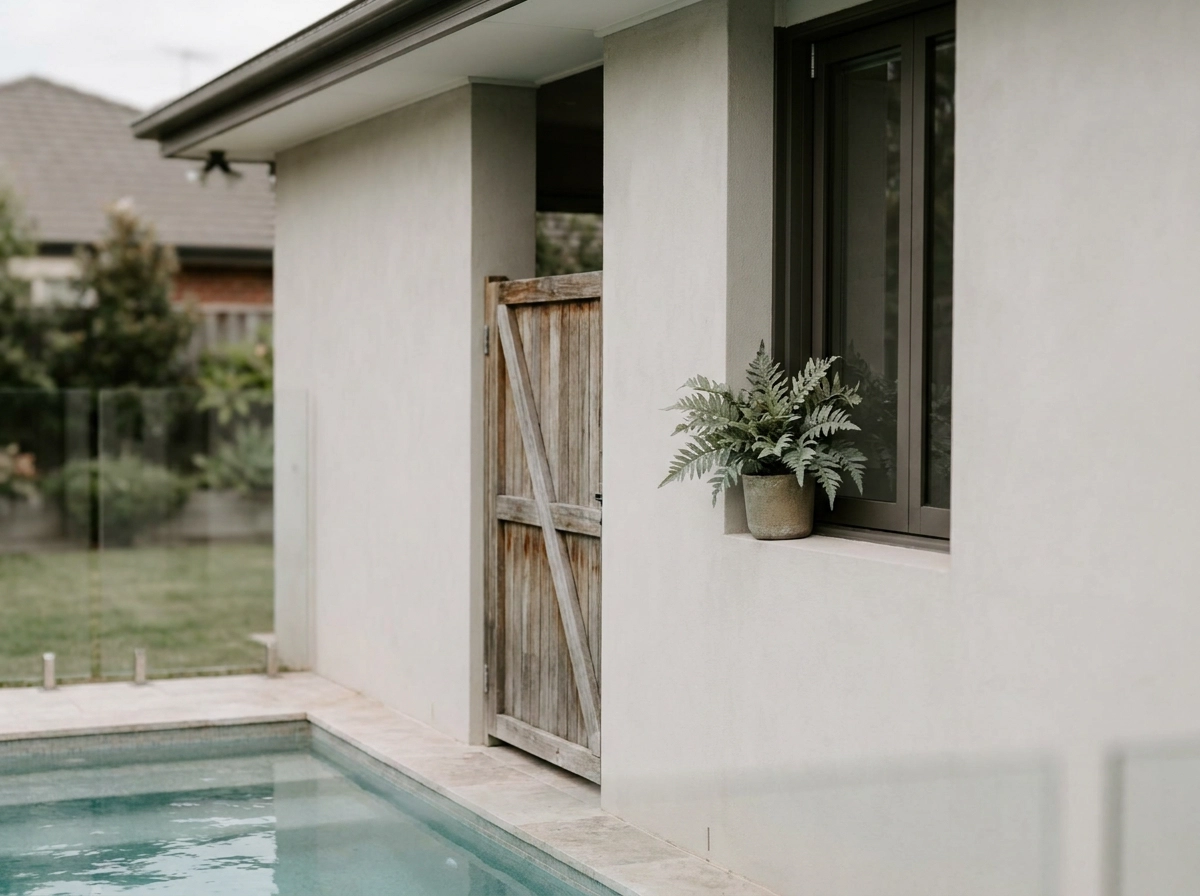
The NCZ covers what’s outside and around your fence, but if your house wall forms one side of the pool barrier, a separate set of rules applies to everything built into that wall.
Using a house wall as part of the barrier is permitted under AS/NZS 1926.1, but every door and window in that wall becomes part of the compliant barrier and is treated accordingly.
Doors in the house wall must have a self-closing, self-latching mechanism, exactly like a pool gate. They cannot be propped open during normal household use. A sliding door wedged open on a hot afternoon is a compliance failure.
Windows present a different issue. Any operable window in that wall facing the pool must not open more than 100 mm unless a compliant restrictor is fitted. A standard fly screen does not qualify.
The inspector will check every door and operable window in that wall, not just the main entry. A laundry door or low bathroom window are frequently missed and easily fixed before inspection day.
If a renovation or extension changes the house wall forming part of the barrier, speak to your council first. Structural changes can invalidate your existing compliance certificate and trigger a full new inspection. New Fence Adelaide can help you think through how barrier configurations affect your fencing scope before work begins.
The Most Common Fail Points on Adelaide Pool Fence Inspections
Beyond the house wall, fence and gate hardware account for most inspection failures. Here are the four fail points that come up most often in Adelaide.
Gate self-latching issues, detailed in the gate mechanisms section above, remain the single most reported fail point.
Climbable objects within the 900 mm outside NCZ (retaining walls, metre boxes, outdoor furniture) are the second most common cited failure.
Barrier height just under 1200 mm catches homeowners by surprise, particularly where a post has settled or garden beds and mulch have raised the ground level outside the fence.
Gaps at the base are easy to miss. The 100 mm rule applies at ground level, including where the fence meets a return wall, step edge, or uneven paving.
If you’re unsure what else might catch you out, our Frequently Asked Questions About Fence Repairs in Adelaide covers common maintenance and compliance queries worth reading before your inspection.
How to Brief Your Fencing Contractor to Pass First Time
Most fail points come down to one thing: the contractor wasn’t briefed on SA requirements before the first panel went in.
Confirm the standard before work starts. Share the SA pool fencing requirements checklist with your contractor and confirm that they are building to AS/NZS 1926.1. That standard should be named explicitly, not just implied.
Verify gate hardware on the day of installation. Before your contractor leaves, ask them to demonstrate gate spring tension, latch engagement, and opening direction in front of you. Fixing a gate spring after the inspector has visited costs more than adjusting it on the day.
Settle the non-climbable zone at design stage. Panel profiles, horizontal rail placement, and decorative elements should be chosen with NCZ compliance built in. For aluminium slat or Colorbond pool fencing, confirm the panel profile doesn’t create a footing pattern on either face within the lower 900 mm; some decorative profiles can introduce NCZ problems.
A contractor with genuine SA pool fencing experience will know the local council inspection process and common local fail points. If you’re unsure what questions to ask before hiring, the frequently asked questions about fencing contractors on our site is a useful starting point.
Getting Your Pool Compliance Certificate in SA: The Process Step by Step
Once your fence is installed and you’ve done your own pre-inspection walk, contact your local council to lodge a formal inspection request; check their website for current lodgement options and required documentation.
An authorised council inspector, or in some cases a private building certifier, will attend your property and assess the barrier against AS/NZS 1926.1 and the relevant BCA provisions.
If the fence passes, a pool compliance certificate SA is issued. This is a legal document. Keep it with your property records as it can be required during a future sale or if a complaint is raised.
If the fence fails, the inspector provides a written remediation list. You’ll need to fix every item and rebook before the certificate is issued. Reinspection fees apply, which is exactly why getting it right the first time matters.
Ask your council when you receive your certificate whether it has a validity period or renewal requirement, practices vary between councils.
The Quickest Way to a Compliant Pool Fence in Adelaide
Once your certificate is issued, the work isn’t quite done. Here’s the short version of everything that keeps you compliant from here:
Before booking your council inspection, complete the pre-inspection walk described above, height, gates, NCZ clearance, and base gaps.
Briefing your contractor on AS/NZS 1926.1 before installation, as detailed earlier, is the single step that eliminates most fail-and-fix cycles.
At handover, ask your contractor to walk you through the inspection checklist so you know exactly what you are responsible for maintaining going forward.
Set an annual NCZ reminder; as noted above, gardens grow and landscaping can push a passing fence out of compliance.
New Fence Adelaide installs pool fencing to AS/NZS 1926.1 specifications across Adelaide and can advise on gate mechanisms, panel profiles, and non-climbable zone requirements before a single panel goes in.
Conclusion
Compliance comes down to briefing your contractor on AS/NZS 1926.1 before installation, passing your self-check before the council visit, and maintaining your barrier afterward. The difference between first-time pass and a fail-and-fix cycle is almost always preparation.
If you are planning a new pool fence in Adelaide, talk to New Fence Adelaide first. Getting the design right from day one is always faster, cheaper, and simpler than fixing it later.