Most Adelaide homeowners spend weeks choosing a fence style, then panic-pick the colour in about five minutes. It’s one of the biggest decisions you can rush, and one of the easiest to get wrong.
Here’s the thing: fence colour isn’t just a matter of personal taste. In Adelaide, it actually matters more than most people realise. Between the terracotta rooflines, limestone renders, and some of the harshest UV radiation in the country, the shade you pick will either sit beautifully with your home for decades or look awkward from day one.
Whether you’re browsing good neighbour fence colours for a shared boundary or trying to find the right Colorbond shade for your front yard, this guide gives you a simple, practical framework to work from. No design degree needed.
We’ll walk you through how to read your roof, your render, and your street before you even open a colour swatch. We’ll also cover which shades hold up best in Adelaide’s summer heat, and how to make a choice you’ll still be happy with ten years from now.
Why Colour Choice Matters More in Adelaide Than Most Places
Adelaide’s summer UV Index regularly sits above 13, an Extreme-rated UV Index that accelerates fading and surface degradation on every exterior finish, including Colorbond fencing.
Colour choice also has a direct thermal impact. On a 40-degree day, a Surfmist fence reaches around 52 degrees at the surface. A Night Sky fence reaches approximately 82 degrees. That 30-degree differential affects comfort in outdoor living areas, puts nearby plants and timber structures under more heat stress, and influences how much the steel expands and contracts across Adelaide’s seasonal temperature swings.
For most Adelaide homeowners, fencing colour is the purchase decision that gets delayed the longest. The hesitation is understandable: you are trying to balance what you like, what will perform well in the heat, and what will still look right in five or ten years.
The stakes are higher than most exterior decisions. A front door colour you dislike can be repainted for a few hundred dollars on a weekend. A Colorbond fence runs the full length of your boundary and is visible from the street every day. Getting it wrong is a costly and time-consuming fix. It pays to get it right the first time, and choosing the right Colorbond fencing for your Adelaide property starts with understanding what you are actually deciding.
Understanding the Colorbond Colour Palette
So before you start shortlisting shades, it helps to understand what you’re actually choosing between.
Colorbond’s core palette covers a range of colours, all pre-finished with a baked-on coating built for Australian conditions. They sit across three broad groups:
- Light and pale tones: Surfmist, Classic Cream, Paperbark
- Mid-range neutrals: Shale Grey, Dune, Wallaby
- Deeper shades: Monument, Ironstone, Night Sky
Every colour in this range is available across standard Colorbond fence panels, Good Neighbour fence panels, and many aluminium slat fencing ranges, so the guidance in the steps below applies regardless of which product type you’re installing. (If you’re still weighing up Colorbond against other materials altogether, this comparison of Colorbond and timber fencing for Adelaide homes is a useful starting point.)
The number that ties colour to thermal behaviour is the Solar Reflectance Index, or SRI. It measures how much solar energy a surface reflects rather than absorbs. Surfmist scores 95; Night Sky scores just 5.
The practical takeaway: before you fall in love with a colour, check where it sits on the light-to-dark spectrum. That tells you how it will behave on an Adelaide summer afternoon, not just how it looks on a sample card.
Step One: Start With Your Roof Colour
The roof is the most visually dominant fixed element on any Adelaide home and sets the tone for everything below it. Your fence will live in that context every day, so working with your roof rather than against it is the simplest way to get a considered result.
If your home has terracotta tiles, common in established Adelaide suburbs, lean toward Colorbond shades like Paperbark, Dune, Wallaby, and Jasper. They share terracotta’s warm orange-red undertones without needing to match exactly, just belonging to the same tonal family is enough.
If your roof is grey concrete or slate-look tile, lean toward cooler neutrals. Shale Grey, Basalt, and Monument all work well, and this combination is increasingly common in newer Adelaide builds and renovations.
If your roof is dark charcoal steel, you have more flexibility because the roof already anchors the home visually. Be cautious about repeating the same dark tone on the fence; on a smaller block without much greenery, it can feel heavy.
The practical rule: match undertone to undertone, warm-to-warm or cool-to-cool. Trying to match exact shades rarely works and tends to date quickly. A good fencing installation professional can help you sense-check your shortlist against what works in your specific street.
Step Two: Read Your Render or Cladding
Once you’ve got your roof undertone sorted, the next layer to check is your walls.
Adelaide has a strong tradition of rendered and limestone-clad homes, especially in older suburbs. These exteriors carry a creamy, warm off-white tone that behaves quite differently from red brick or painted weatherboard when fence colours are placed alongside them.
Limestone and cream render are forgiving with warm Colorbond tones. Paperbark, Classic Cream, Dune, and Gully all sit comfortably next to that warm off-white without competing or creating visual tension.
Grey or white render suits cooler fence options. Shale Grey, Surfmist, and Windspray work well here, and these pairings are increasingly common in newer Adelaide builds and knockdown-rebuilds where the exterior palette runs cooler overall.
Red or orange-brown brick, common across mid-century Adelaide homes, already carries significant visual weight. Adding a warm or vivid fence colour can push the combination too far. A neutral mid-tone like Wallaby or Woodland Grey sits back quietly rather than amplifying what the brick is already doing.
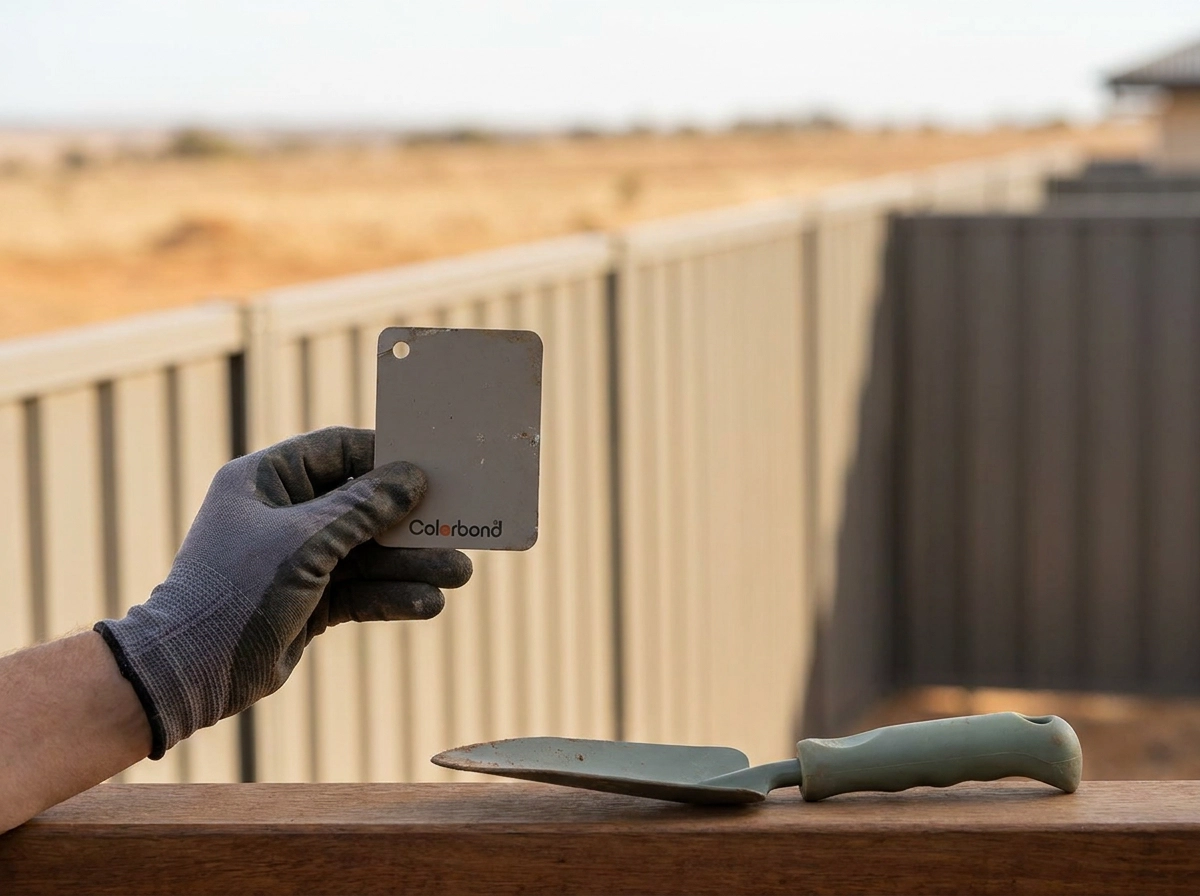
Whatever your wall material, hold a physical Colorbond sample against it in the afternoon sun before you commit. Adelaide’s intense light reads colours very differently from the overcast conditions that most colour-chip photography is shot under. If you’re planning a fence in a southern suburb, the team at New Fence Adelaide serving Christie Downs and surrounds can walk you through this on site.
Step Three: Consider Your Streetscape
Once you have matched your fence to your roof and render, zoom out and look at the street.
Your fence sits on the boundary, visible to anyone passing by, and it visually connects your home to the properties on either side. A colour that works in isolation can still look jarring if it clashes with the broader street palette.
In Adelaide streets with consistent warm tones, think terracotta roofs, brick, and render, a fence in earthy neutrals like Dune, Wallaby, or Paperbark reads as belonging. A high-contrast choice in the same setting can look like an afterthought rather than a considered decision.
Contrast is not off the table, but it needs to be deliberate. A deep Ironstone fence against light render can look sharp and contemporary. The same dark tone dropped into a warm, traditional streetscape without supporting context tends to look mismatched.
If you live in a heritage or character suburb, such as Colonel Light Gardens or other areas with council overlays, check with your local council before committing to a dramatically different tone. Some areas have formal guidelines around fence materials and colours.
Good Neighbour panels show the same face to both sides of the boundary, so your colour choice affects your neighbour’s streetscape as much as your own. Mid-range neutrals tend to be the safest starting point for shared boundaries.
For help thinking through what works in your specific street, Why Choose New Fence Adelaide explains how the team approaches these decisions with local experience behind them.
Thermal Performance: What Adelaide Summers Do to a Dark Fence
Colour affects more than how your fence looks. On a 40-degree Adelaide afternoon, it affects how your backyard actually feels.
The gap runs from 52°C for Surfmist to 82°C for Night Sky, a 30-degree spread established earlier, but the direction that fence faces matters too. That heat radiates outward, warming the alfresco area beside it, stressing nearby plants, and making the steel dangerous to touch during peak hours. If you have young children or pets using that space, it is a real consideration.
Lighter tones perform noticeably better. Classic Cream reaches approximately 56°C and Paperbark around 59°C, keeping the fence line far more manageable in outdoor living zones.
The practical case aligns with the aesthetic one. Adelaide’s established streetscapes skew warm and light, limestone renders, terracotta rooflines, cream brickwork. A lighter fence not only performs better in the heat but tends to sit more naturally within that context.
If heat, sun damage, or age has already taken a toll on your existing fence, this guide on how to tell when your Adelaide fence needs repair versus full replacement can help you decide what to do before thinking about new colours.
Which Colours Hold Their Look Longest in Adelaide’s UV
Heat is one side of the UV story. The other is what Adelaide’s sun does to colour over time.
Given Adelaide’s extreme-rated UV Index, fading affects every exterior finish over time. Colorbond’s factory-applied coating is designed for Australian conditions, but no finish is completely immune.
Fading almost always manifests as a lightening of tone. On pale colours like Surfmist or Classic Cream, that shift is barely perceptible. On deep charcoals like Night Sky or Ironstone, the same degree of fading is obvious because the contrast against the original tone is far greater.
Mid-range earthy tones sit in the sweet spot. Colours like Paperbark, Dune, and Woodland Grey retain their warmth even as UV works on the surface, because natural tonal variation absorbs the change without looking washed out.
Some homeowners report a dulling of sheen on very dark tones over time, factor this into maintenance expectations if choosing Monument, Night Sky, or Ironstone.
The same logic applies to aluminium slat fencing colours, which are typically powder-coated rather than thermally cured. Mid and lighter tones age more gracefully in Adelaide’s conditions, so the same warm-to-warm or cool-to-cool matching principles carry across to slat fencing selections.
A Simple Framework for Matching Colorbond Fencing to Your Home
Knowing what ages well narrows your shortlist. Now put that knowledge into a working process.
Step 1: Start with your roof undertone, warm for terracotta, cool for concrete, as covered earlier, and shortlist fence colours that share it.
Step 2: Hold physical samples against your actual wall at different times of day before committing.
Step 3: Use the Colorbond colour visualiser first. The online visualiser is a useful starting point before ordering physical samples. Never make a final decision from a screen alone.
Step 4: Factor in your thermal zone. If the fence faces west or north, or bounds an outdoor living area, lean toward lighter or mid tones. Going dark is valid, but treat it as a deliberate decision with heat trade-offs you’re comfortable accepting.
Step 5: Ask your installer for real examples. Full panels installed in your preferred colours tell you far more than a small chip. Installers working regularly across Adelaide suburbs have seen firsthand what holds up locally. It’s also worth reading up on how Colorbond fence costs break down in Adelaide so colour and budget conversations happen at the same time.
Good Neighbour and Aluminium Slat Fencing Colours: Same Rules Apply
The same colour logic covered throughout this guide applies directly to Good Neighbour fence panels, since they are manufactured using Colorbond steel and available across the Colorbond colour range.
One thing to keep in mind with Good Neighbour fencing specifically: the capping rail and pickets present an identical finished face to both sides of the boundary. The colour you choose is the colour your neighbour lives with too. Mid-range neutrals like Dune, Wallaby, and Shale Grey remain the safest starting point, as with any shared boundary, your choice is your neighbour’s view too. They sit comfortably alongside a wide range of roof and render combinations on both sides of the fence.
Aluminium slat fencing follows a similar approach. Powder-coat colour ranges for aluminium slats closely mirror the Colorbond palette in tone and finish, so the warm-to-warm and cool-to-cool matching principles still apply.
Where aluminium slats are used as privacy screens or feature panels rather than full boundary runs, you have a little more room to go darker or more contemporary. A smaller panel reads as an architectural detail rather than a dominant boundary element, so a bolder colour choice carries less visual risk.
Choosing a Fence Colour That Still Looks Right in Ten Years
The same logic runs through every product type covered in this guide. Now it comes down to locking in a decision you will still be happy with a decade from now.
Start with the fixed elements: your roof undertone, your render, and your street. Personal preference matters, but it should refine a shortlist shaped by those anchors, not drive it from scratch.
The UV and thermal advantages of mid tones like Paperbark, Dune, and Shale Grey remain real long after installation.
Use the visualiser to narrow your shortlist, then test physical samples in Adelaide’s afternoon light as outlined above.
Finally, talk to an installer who works regularly across Adelaide suburbs. Seeing completed jobs in your shortlisted colours gives you far more confidence than a small chip ever will, and a good installer will flag what holds up well locally.
New Fence Adelaide installs Colorbond, Good Neighbour, and aluminium slat fencing across Adelaide. If you want to work through colour and product decisions before a single panel goes in, get in touch and we can help from the start.
Conclusion
Choosing the right Colorbond fencing colour for your Adelaide home comes down to four fundamentals: match your roof undertone first, read your render or cladding second, respect your streetscape third, and factor in Adelaide’s intense UV when weighing lighter tones against deeper shades.
Get those anchors right and the decision becomes straightforward rather than overwhelming. Colours like Paperbark, Dune, and Shale Grey consistently reward Adelaide homeowners with lasting performance, cooler surfaces, and a look that still feels considered years down the track.
A great fence does more than mark a boundary. It lifts the entire street presence of your home.
Ready to move from shortlist to installed? New Fence Adelaide works with homeowners across Adelaide to get colour and product decisions right before installation day. Get in touch and let us help you choose a fence you will be proud of for years to come.