
Your fence is doing its job, but it is not quite doing enough. Maybe the neighbours have a new two-storey deck overlooking your backyard, or perhaps you just want a bit more separation between your outdoor space and the street. Whatever the reason, the first question most Adelaide homeowners ask is a sensible one: can I just make my existing fence taller instead of replacing the whole thing?
It sounds simple, but fence extensions in Adelaide come with a few moving parts that are worth understanding before you grab a quote. There are structural questions about whether your current posts can handle the extra height, local rules about how tall your fence can actually go, and a neighbour consent process that catches a lot of people off guard.
This post walks you through all of it in plain language. You will learn how Colorbond extensions work in practice, what South Australian regulations allow, when you need council approval, and how to figure out whether extending your fence is genuinely the smarter move or whether a full replacement makes more sense in the long run.
How Colorbond Fence Extensions Actually Work
When Adelaide homeowners talk about “extending” a fence, they’re describing two quite different types of work.
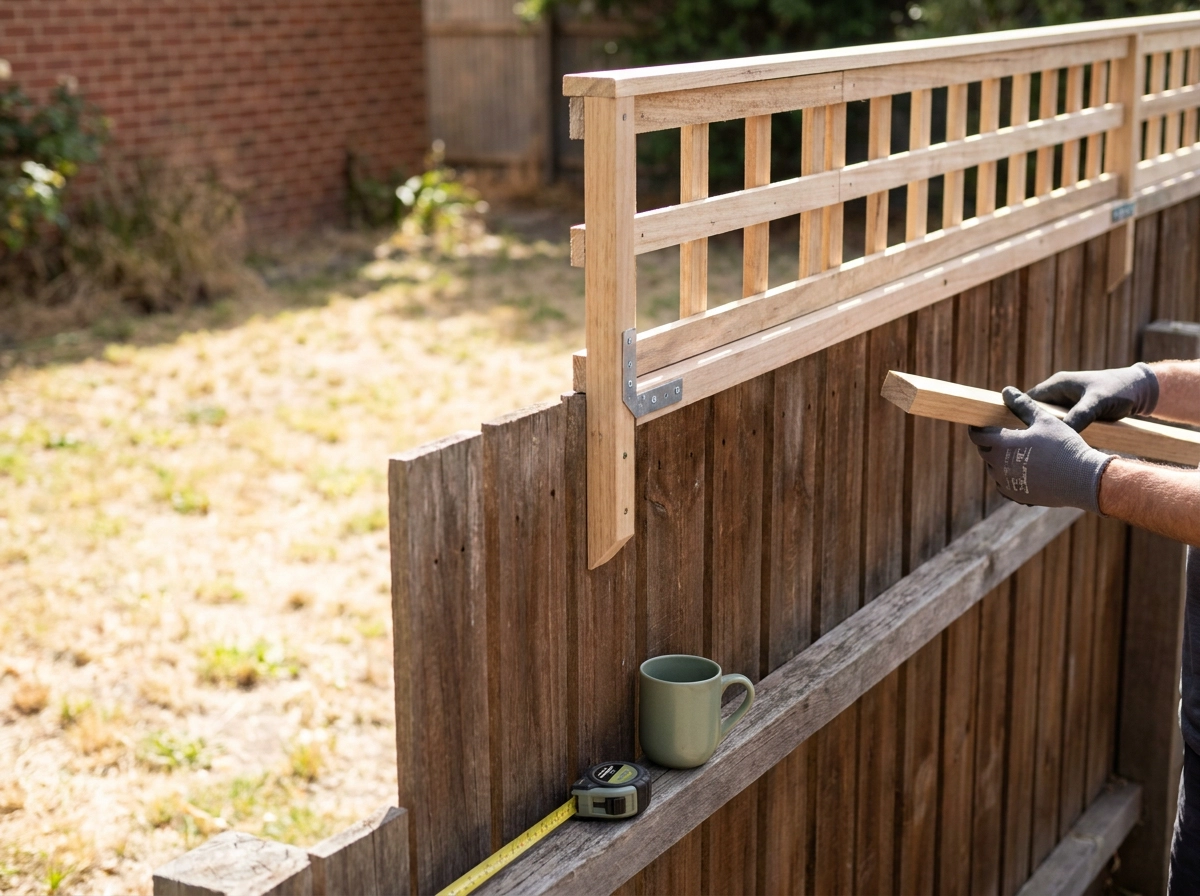
The first method uses fence toppers: lattice panels, timber slats, or Colorbond infill sections fixed directly above the existing top rail. The original frame stays in place; the topper adds height without touching the posts or rails below.
The second method involves replacing the sheeting entirely with taller Colorbond panels while keeping the existing posts. The frame stays, but the visible panels are swapped out for ones that reach a greater height.
Both approaches appeal to homeowners for the same reason: they look cheaper and faster than starting fresh. There’s less digging, less disposal, and less disruption. For a fence that’s otherwise in solid condition, that logic can hold up.
The catch is that “extension” gets used loosely to describe everything from clipping a privacy screen above the top rail to a full structural re-sheeting job that places real additional load on existing posts. Those two scenarios have very different implications for cost and for what approvals or structural checks may be required.
Knowing exactly which type of extension is being proposed is the essential first step, before anyone discusses whether the posts can handle it, whether council approval is needed, or what the job will actually cost. Our Colorbond fencing services cover both extension approaches, and if you’re in the southern suburbs, the team handling Colorbond fencing, new fences and repairs in Aberfoyle Park can help clarify which option suits your existing setup.
The Structural Question: Can Your Existing Posts Handle the Extra Load?
Once you’ve understood what type of extension you’re dealing with, the next question is the most critical one: can the existing structure actually handle the extra height?
Here’s what most homeowners don’t realise. Colorbond posts and rails are engineered for a specific fence height at installation. A fence built to 1.8 metres uses post embedment depths and steel gauges calculated for that load. Those same posts aren’t automatically rated to carry a 2.1 metre fence.
Why wind load matters more than you might think
Adding panels above the existing top rail increases wind pressure acting on every post in the ground. In Adelaide, this isn’t theoretical. Summer storms and strong northerly winds regularly push fences to their limits, and a post that copes at 1.8 metres can fail under the load of an extended fence during the first serious weather event. Fence wind load and structural engineering standards confirm that increasing fence height raises the moment load on posts significantly, not proportionally.
What you can’t see above the ground
Posts exposed to storm events, moisture, or soil movement can lose structural integrity without showing obvious signs at the surface. A post that looks solid at ground level may be corroded or poorly embedded below it. This is common in older fences or those repaired in sections over the years, where post depths and rail conditions vary across the same fence line.
That patchwork history makes extension genuinely risky. If the posts fail, you’re looking at a full replacement at greater cost than if you’d replaced the fence from the start. For a realistic sense of what that involves, the Adelaide Colorbond fence cost guide is worth reading before making any decisions.
A qualified fencing contractor can assess post embedment depth, rail condition, and panel integrity to confirm whether your fence is extension-ready.
Height Limits for Fences in South Australia: What the Rules Actually Say
Once you’re confident the structure can handle the load, the next question is whether the height you’re aiming for is even legal without a permit.
The good news for Adelaide homeowners is that South Australia has one of the most generous approval-free thresholds in the country. Under Schedule 4 of the Planning, Development and Infrastructure (General) Regulations 2017%20regulations%202017/current/2017.24.auth.pdf), non-masonry fences, including Colorbond, timber, steel and aluminium, can be built up to 2.1 metres without development approval. NSW caps the same fence types at 1.8m, and Victoria, Queensland and Tasmania at 2.0m. That extra clearance gives Adelaide homeowners meaningful room to work before a permit enters the picture.
Masonry fences are treated very differently. Brick or rendered block fences hit the approval threshold at just 1 metre, so if your boundary includes any masonry sections, the rules change significantly.
Corner lots carry an important exception regardless of material. If your fence sits within 6 metres of a road intersection, it is capped at 1 metre. This applies to Colorbond just as much as brick, so corner property owners should confirm whether their fence falls within that zone before planning any extension.
It is also worth knowing that since 19 March 2021, South Australia has operated under a single statewide Planning and Design Code, replacing the old patchwork of council-by-council Development Plans. The rules are now consistent across Adelaide, so you no longer need to dig through your specific council’s documents to find the answer.
If a proposed extension would push your fence above 2.1m, development approval is required and is not guaranteed, particularly in heritage zones or certain planning overlays. Similar approval requirements apply to pool fencing in South Australia, where getting the rules wrong before installation leads to costly rework.
Neighbour Consent: The Step Most Adelaide Homeowners Skip
Even if your proposed extension sits within South Australia’s 2.1 metre limit, you still need your neighbour’s written consent before any work begins.
Under the Fences Act 1975, written consent is required before commencing any fence repair, maintenance, replacement or extension work. It doesn’t matter whether you’re paying the full cost yourself. The requirement applies regardless.
For non-urgent work, the formal process involves delivering a notice of intention to your neighbour. They then have 30 days to lodge a cross-notice (an objection). If no written objection arrives within 30 days, consent can be assumed. Skip the notice entirely, though, and you’re exposed to disputes and potential legal liability, even if the finished fence looks completely reasonable.
Consent matters because dividing fences are jointly owned by both neighbouring property owners, regardless of who originally built or paid for the fence. Neither party can unilaterally extend or alter it.
It’s also worth knowing that the fence’s existing position doesn’t confirm where the legal boundary sits. Only a licensed surveyor can establish that formally. If any disagreement arises about fence placement, a surveyor’s determination is the only one that counts legally.
Get written consent early, before you order materials or confirm a contractor. A dispute that surfaces after work is underway is far harder and more expensive to resolve. If you’re uncertain whether your existing fence is worth extending at all, this guide on deciding between repair and full replacement for your Adelaide fence is worth reading before you commit.
Who Pays for a Fence Extension in Adelaide?
Once you’ve sorted neighbour consent, the next question most homeowners ask is: who actually pays for this?
Under South Australian dividing fence law, the 50/50 cost-sharing principle applies only to a sufficient dividing fence. That means a standard fence that meets the basic legal requirement for your boundary, nothing more. Think of it as the minimum acceptable fence for that location.
If you want to raise your fence beyond that standard, say from 1.8m to 2.1m for extra privacy, that additional cost falls entirely on you. Your neighbour has no legal obligation to chip in, even if the proposed height is perfectly within the approval-free limit.
This is where a lot of homeowners get caught out. Many assume that because 2.1m is legal, the neighbour must share the cost. That logic doesn’t hold up. Legal permissibility and shared cost liability are two different things. Your neighbour is only obligated to contribute toward bringing or keeping a fence up to a sufficient standard. Anything above that is considered a personal upgrade on your part.
The good news is that if your neighbour actually wants a taller fence too, you can work out a cost-sharing arrangement between yourselves privately. Plenty of Adelaide neighbours do exactly that. There’s just no legal mechanism to compel them if they’d rather not contribute.
For installation work done right from the outset, specialising in fencing Adelaide work home owners can rely on makes the difference between a fence that holds its value and one that creates headaches down the track.
Extension or Full Replacement: Making the Right Call for Your Fence
Once you’ve sorted out who’s paying, the next question is whether extending is actually worth doing at all, and that comes down to the condition of what’s already in the ground.
Extension tends to make sense when:
- The fence is relatively new (under 10 years old)
- Posts are properly embedded and showing no signs of movement
- You’re making a modest height increase, such as going from 1.8m to 2.1m
Replacement is usually the smarter call when:
- Posts are moving, showing rust at ground level, or have taken storm damage
- The fence has had multiple panel repairs over the years, pointing to inconsistent post depths and rail conditions that an extension would put under pressure
Older fences with a patchwork repair history are particularly worth scrutinising. Each repair may have been done to a slightly different standard, and adding height to that kind of frame creates unpredictable weak points.
If you’re researching a 2.4m Colorbond fence, it’s worth knowing upfront that 2.4m exceeds South Australia’s 2.1m approval-free limit. You’d need development approval, and existing posts built for a standard-height fence almost certainly couldn’t carry that load without a full frame replacement regardless.
On cost: an extension that fails in Adelaide’s summer storms and then needs a full replacement will end up costing considerably more than replacing the fence properly from the start. A structural assessment before you commit is the most cost-effective step you can take.
A good fencing contractor should give you a clear, honest answer on this. If you want to understand what that assessment involves, our approach to fence repairs at New Fence Adelaide explains what we look for and why it matters.
What a Proper Fence Assessment Should Cover Before Any Extension Work
So you’ve decided an assessment makes sense before committing either way. Here’s what a thorough inspection should actually cover.
- Post embedment depth and condition. Posts need to be buried to the manufacturer’s specification for the target fence height. A post installed for a 1.8m fence may not be embedded deeply enough to handle 2.1m of panel. Visible corrosion at or below ground level is a serious warning sign, because the worst rust is usually what you can’t see.
- Rail integrity. The top, mid and bottom rails should be checked for rust, deformation and loose fixings. This matters more after Adelaide’s summer storms, which put real stress on rail connections even when no visible damage is obvious.
- Panel condition. Existing Colorbond sheeting should be free of significant denting, corrosion or bodged repairs. If the sheeting is in poor shape, extension panels may not align or fix cleanly, and the finished result will show it. Reviewing why fence maintenance matters can help you understand how small issues compound over time.
- Height against the 2.1m threshold. Measure the proposed final height before anything is ordered. If it exceeds 2.1m, development approval is required and that changes the entire project scope.
- Boundary confirmation. If there’s any doubt about where the boundary actually sits, raise it now. Only a licensed surveyor can confirm the legal boundary position, and it’s far less disruptive to sort out before materials are purchased.
- Neighbour consent status. A good contractor flags the written consent requirement during scoping, not after work has started. This protects both parties and keeps the project on solid legal ground.
The Bottom Line on Colorbond Fence Extensions in Adelaide
Once you’ve had the assessment done, you’re in a much stronger position to decide what actually makes sense for your fence.
Raising an existing Colorbond fence is absolutely viable in Adelaide, but only when the structure underneath can genuinely handle the extra load. That’s not something to assume; it needs to be confirmed by someone who knows what to look for.
South Australia’s 2.1m approval-free limit gives homeowners more flexibility than most other states, but the rules aren’t uniform across every situation. Corner lots, masonry fences, and anything proposed above 2.1m all carry specific requirements worth checking before work begins.
Written neighbour consent is a legal requirement before any fence work starts. It isn’t a formality you can skip because the job looks straightforward, and it isn’t negotiable regardless of how minor the extension seems.
If you’re weighing up an extension against a full replacement, or looking for dependable fence repairs in Adelaide, the smartest first move is getting an honest assessment of what you’re currently working with. Committing money to an extension that later fails in a storm is a far more expensive outcome than making the right call upfront.
New Fence Adelaide can inspect your existing fence, assess whether the posts and rails are genuinely up to the job, explain the height rules that apply to your specific property, and give you a clear quote for either an extension or a full replacement. No guessing, no surprises, just straightforward advice so you can move forward with confidence.
Conclusion
Raising a Colorbond fence in Adelaide is a smart, cost-effective option, but only when the right conditions are in place. Keep these key points in mind before moving forward.
Your existing posts must be structurally sound enough to handle the additional load. South Australia’s 2.1m approval-free height limit offers genuine flexibility, though corner lots and special situations carry their own requirements. Written neighbour consent is a legal obligation, not an optional courtesy. And sometimes, full replacement is simply the smarter financial decision long-term.
Getting an honest professional assessment before committing to any work saves you from costly mistakes down the track. Whether you need an extension, a full replacement, or reliable fence repairs in Adelaide, the right advice upfront makes all the difference.
Contact New Fence Adelaide today for a thorough inspection and clear, straightforward quote. Make your decision with confidence, not guesswork.